
中文版:
《传媒可持续发展·ESG专栏》(第三期)
深度解读附件:《”第一届传媒业可持续发展指数评级模型”正式发布》——一套可借鉴的传媒业ESG评估方法论
亲爱的联合国教科文组织媒介素养联盟成员们:
在本期专栏中,我们将聚焦随信附件的技术文档,向您系统介绍2025年在中国首次应用的 “传媒业可持续发展VPI评级模型” 。这份文档不仅记录了中国传媒业在ESG标准化评估上的探索,更重要的是,它提供了一套可适配、可迁移的行业评估框架,对全球传媒业的可持续发展实践具有参考价值。
核心提炼:VPI模型如何适配传媒业特质
附件详细阐述了该模型对香港中文大学原始VPI框架的适配性改造。我们认为,以下四个要点对国际传媒同行尤为关键:
- 行业特质的模型化转化:针对传媒业”内容驱动、数字属性、快速传播、受众广泛、技术变革”五大差异化特征,模型未推翻VPI原框架,而是通过补充行业专属指标实现”通用逻辑+行业特性”融合。
- “价值观-过程-影响”的闭环验证:V(价值观)占20%,P(过程)占50%(其中管理20%、实践30%),I(影响)占30%的权重分配,强制要求企业证明”理念是否驱动行动,行动是否产生实效”。这对识别”漂绿”行为具有制度性约束力,其三级指标设计可参见附件原文。
- 全透明的流程设计:模型采用”前期调研→问卷填写→企业反馈→SGS监督”四阶段闭环。特别值得注意的是,企业可对组委会填报的问卷提出异议并修正,这一机制确保了数据准确性,也赋予被评企业参与权。
- 八级评级体系的激励功能:不设简单及格线,而将企业划分为”典范者(90-100分)”至”初阶探索者(30分以下)”八个层级。这种精细分级旨在降低中小企业参与门槛,同时为头部企业提供持续进步空间。附件中的评分表可直接用于其他国家的试点评级。
对联合国媒介素养伙伴的潜在价值
这套模型的意义不止于中国本土实践:
- 为发展中国家提供”快速启动包”:传媒业ESG标准在全球范围内尚处空白。该模型经85家中国企业验证(涵盖电视、数字媒体、游戏等六大赛道),其指标库与问卷模板可直接作为您所在国传媒业ESG建设的”1.0版本”,节省从零开发的成本。
- 强化媒介素养教育的实证工具:模型中的”I(影响)”维度,量化评估了传媒内容在环保理念普及、正向价值观传播、公共教育贡献等方面的社会价值。这可为UNESCO媒介素养项目提供可测量的成果评估框架,将抽象的传播效果转化为数据指标。
行业的可持续转型始于共识,而成于工具。这套模型是中国传媒人为全球同行准备的一份”开源方案”,期待与诸位共同迭代完善。
浅度
《传媒1号》主编
中国新闻文化促进会教育传播专委会副秘书长
邮箱:786601271@qq.com
英文版:
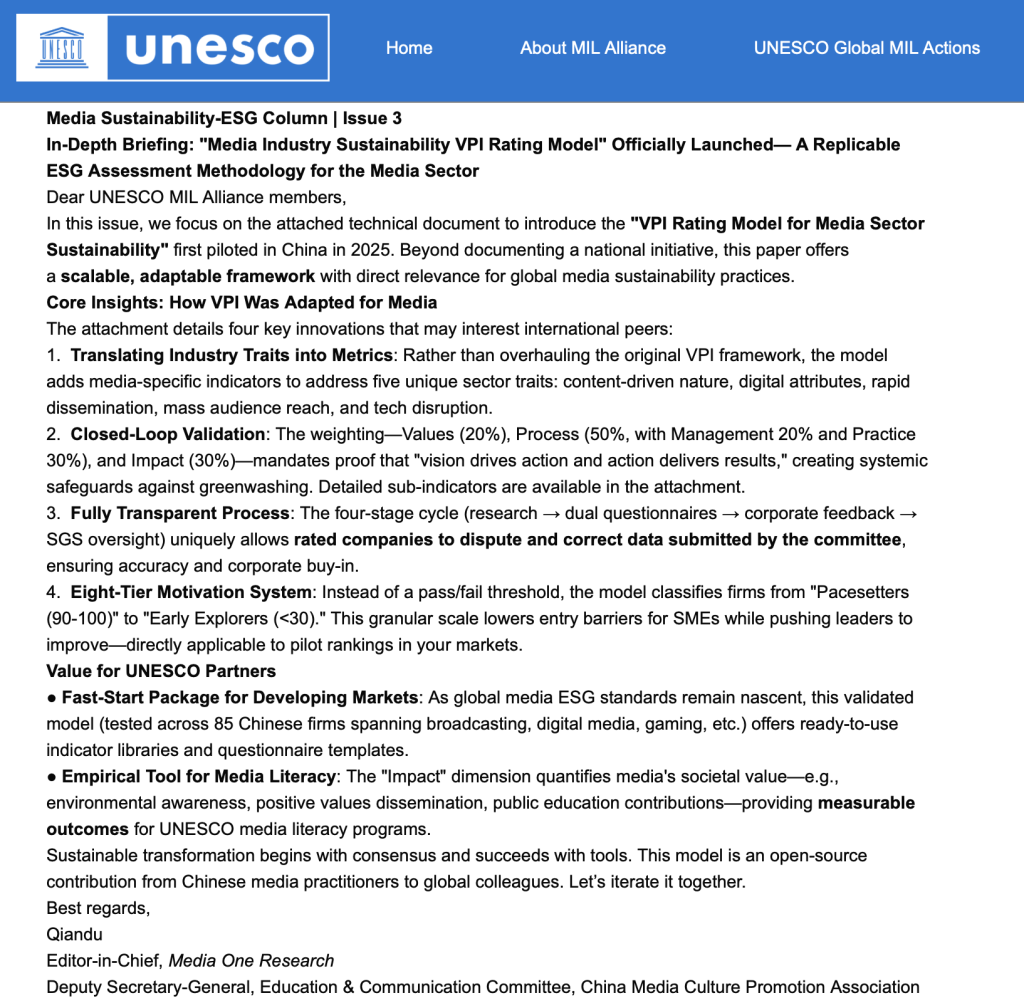
Media Sustainability-ESG Column | Issue 3
In-Depth Briefing: “Media Industry Sustainability VPI Rating Model” Officially Launched— A Replicable ESG Assessment Methodology for the Media Sector
Dear UNESCO MIL Alliance members,
In this issue, we focus on the attached technical document to introduce the “VPI Rating Model for Media Sector Sustainability” first piloted in China in 2025. Beyond documenting a national initiative, this paper offers a scalable, adaptable framework with direct relevance for global media sustainability practices.
Core Insights: How VPI Was Adapted for Media
The attachment details four key innovations that may interest international peers:
- Translating Industry Traits into Metrics: Rather than overhauling the original VPI framework, the model adds media-specific indicators to address five unique sector traits: content-driven nature, digital attributes, rapid dissemination, mass audience reach, and tech disruption.
- Closed-Loop Validation: The weighting—Values (20%), Process (50%, with Management 20% and Practice 30%), and Impact (30%)—mandates proof that “vision drives action and action delivers results,” creating systemic safeguards against greenwashing. Detailed sub-indicators are available in the attachment.
- Fully Transparent Process: The four-stage cycle (research → dual questionnaires → corporate feedback → SGS oversight) uniquely allows rated companies to dispute and correct data submitted by the committee, ensuring accuracy and corporate buy-in.
- Eight-Tier Motivation System: Instead of a pass/fail threshold, the model classifies firms from “Pacesetters (90-100)” to “Early Explorers (<30).” This granular scale lowers entry barriers for SMEs while pushing leaders to improve—directly applicable to pilot rankings in your markets.
Value for UNESCO Partners
- Fast-Start Package for Developing Markets: As global media ESG standards remain nascent, this validated model (tested across 85 Chinese firms spanning broadcasting, digital media, gaming, etc.) offers ready-to-use indicator libraries and questionnaire templates.
- Empirical Tool for Media Literacy: The “Impact” dimension quantifies media’s societal value—e.g., environmental awareness, positive values dissemination, public education contributions—providing measurable outcomes for UNESCO media literacy programs.
Sustainable transformation begins with consensus and succeeds with tools. This model is an open-source contribution from Chinese media practitioners to global colleagues. Let’s iterate it together.
Best regards,
Qiandu
Editor-in-Chief, Media One Research
Deputy Secretary-General, Education & Communication Committee, China Media Culture Promotion Association
Email: 786601271@qq.com